How Do You Know If a Leaning Tree Is About to Fail?
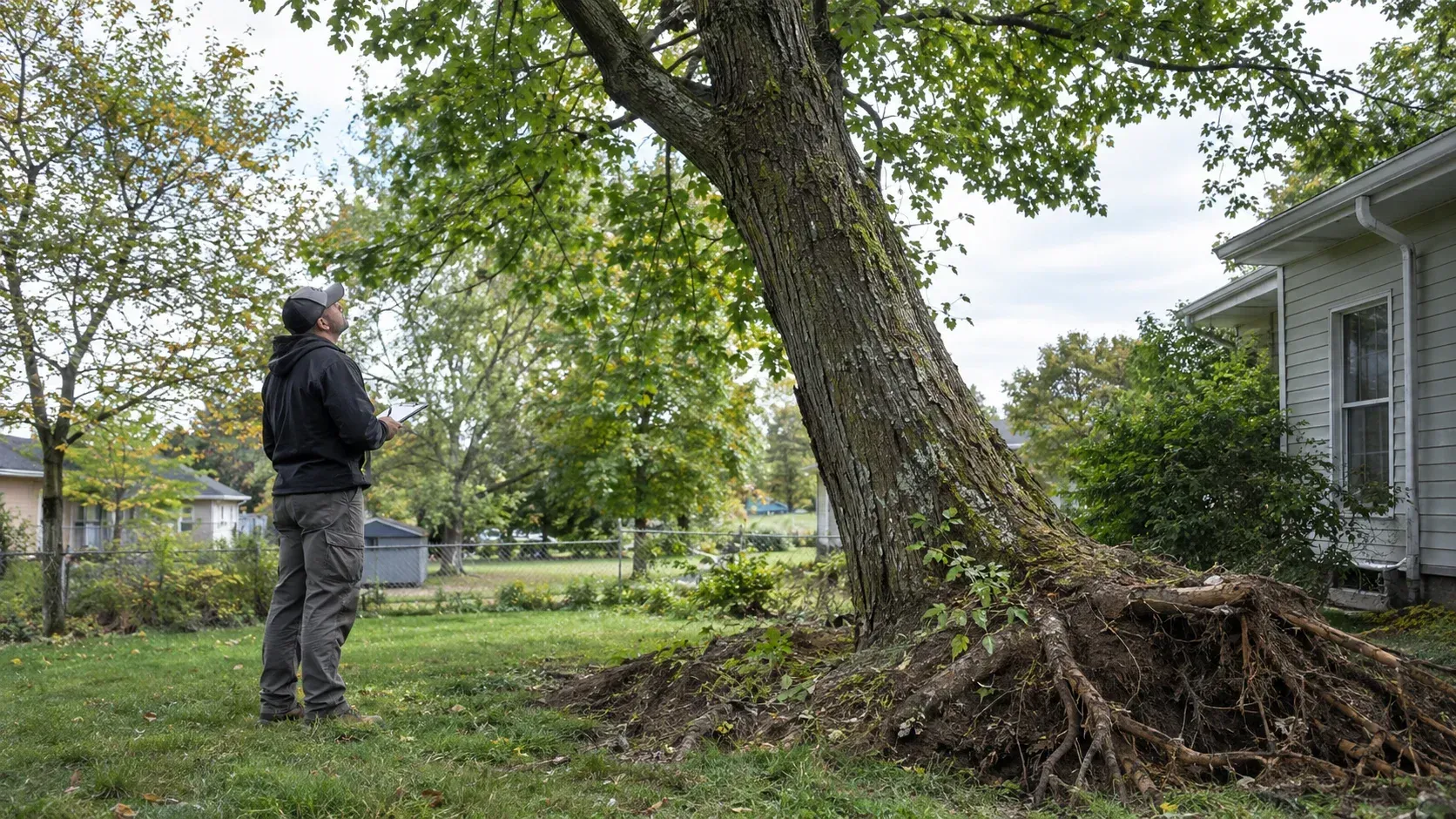
Table of Contents
- Introduction
- Leaning Tree About to Fall: The Warning Signs That Matter Most
- Why a New Lean Is the Whole Question
- Root Heaving and What the Ground Is Telling You
- Tree Lean Danger Signs at the Trunk
- Tree Failure Indicators in the Canopy and Branches
- When a Lean Is Not a Problem
- What Makes a Leaning Tree Urgent Rather Than Concerning
- What to Do Tonight If You Are Worried
- Conclusion
Key Takeaways
- A lean that is new, or has visibly increased, is the signal. A lean the tree grew with over decades usually is not.
- Soil heaving or cracking on the side opposite the lean is the clearest warning sign there is. It means the root plate is lifting.
- Check the base before anything else. Exposed or snapped roots, a lifted root collar, and disturbed soil all say more than the angle of the trunk.
- Curved trunk means the tree grew that way. Straight trunk at an angle means something moved it.
- If the ground at the base is disturbed and the tree is over anything that matters, that is a same-day call, not a next-week one.
Introduction
A leaning tree is most concerning when the lean is new or has visibly increased, and when it comes with soil heaving or cracking on the side opposite the lean, exposed or snapped roots, or a root collar that has lifted at the base of the trunk. Those signs together mean the root plate is failing, and a root plate that has started to lift does not settle back down. A tree that has simply grown at an angle for thirty years is a completely different situation, and it is the more common one.
We assess leaning trees regularly around Lakeville, and most of them turn out to be fine. The ones that are not tend to announce it at ground level rather than in the canopy, which is why the decision to take one down gets made standing at the base with a shovel, not looking up from the driveway.
Here is the checklist we actually work through, in the order we work through it.
Leaning Tree About to Fall: The Warning Signs That Matter Most
If you read nothing else, read this list. Roughly in order of how much weight each carries:
- Soil heaving, cracking or lifting on the side opposite the lean. The most significant sign. It means the root plate is rotating out of the ground.
- A gap or void where the trunk meets the soil, particularly on the low side.
- Roots visibly exposed, torn or snapped, especially on the high side.
- The lean changed recently, or is continuing to change.
- A straight trunk at an angle, as opposed to a curved trunk. Straight and tilted means the whole tree moved.
- Fresh cracks in the trunk, particularly at the base or running vertically.
- Mushrooms or shelf fungi at the base, on the trunk or on surface roots.
- A lifted or exposed root collar, where the flare has come up out of the ground.
- The tree moves in wind in a way it did not used to, or the soil around the base moves with it.
- Recent site work near the tree: trenching, excavation, a driveway, a foundation, grading.
Any one of the first four is reason to have somebody look this week. Several together, over a target that matters, is not a this-week problem.
Why a New Lean Is the Whole Question
The single most useful distinction in this article is between a lean the tree grew into and a lean that happened to the tree.
Grown lean. Trees lean toward light, away from competition, away from prevailing wind. This happens across years, and the tree adapts as it goes. It puts on reaction wood to strengthen the loaded side, and the root system develops to match the load. The trunk usually shows a curve, because the tree kept growing upward from an angled base. This kind of lean is generally stable, and plenty of these trees outlive the people worrying about them.
Acquired lean. Something moved the tree. Root failure, soil failure, saturation, a storm, excavation. The trunk is often straight but tilted, because the whole stem rotated rather than growing crooked. The root system never adapted, because there was no time. This is the one that matters.
How to tell which you have:
- Look at the trunk shape. Curved suggests grown. Straight and tilted suggests moved.
- Look at the soil at the base, which is the tiebreaker.
- Check old photographs. This is genuinely useful and almost nobody thinks of it. Real estate listing photos, family pictures in the yard, anything showing that tree a few years ago.
- Ask how long it has been like that. If nobody can remember it being upright, that is information.
If you cannot establish whether the lean is new, treat it as new until somebody qualified says otherwise.
Root Heaving and What the Ground Is Telling You
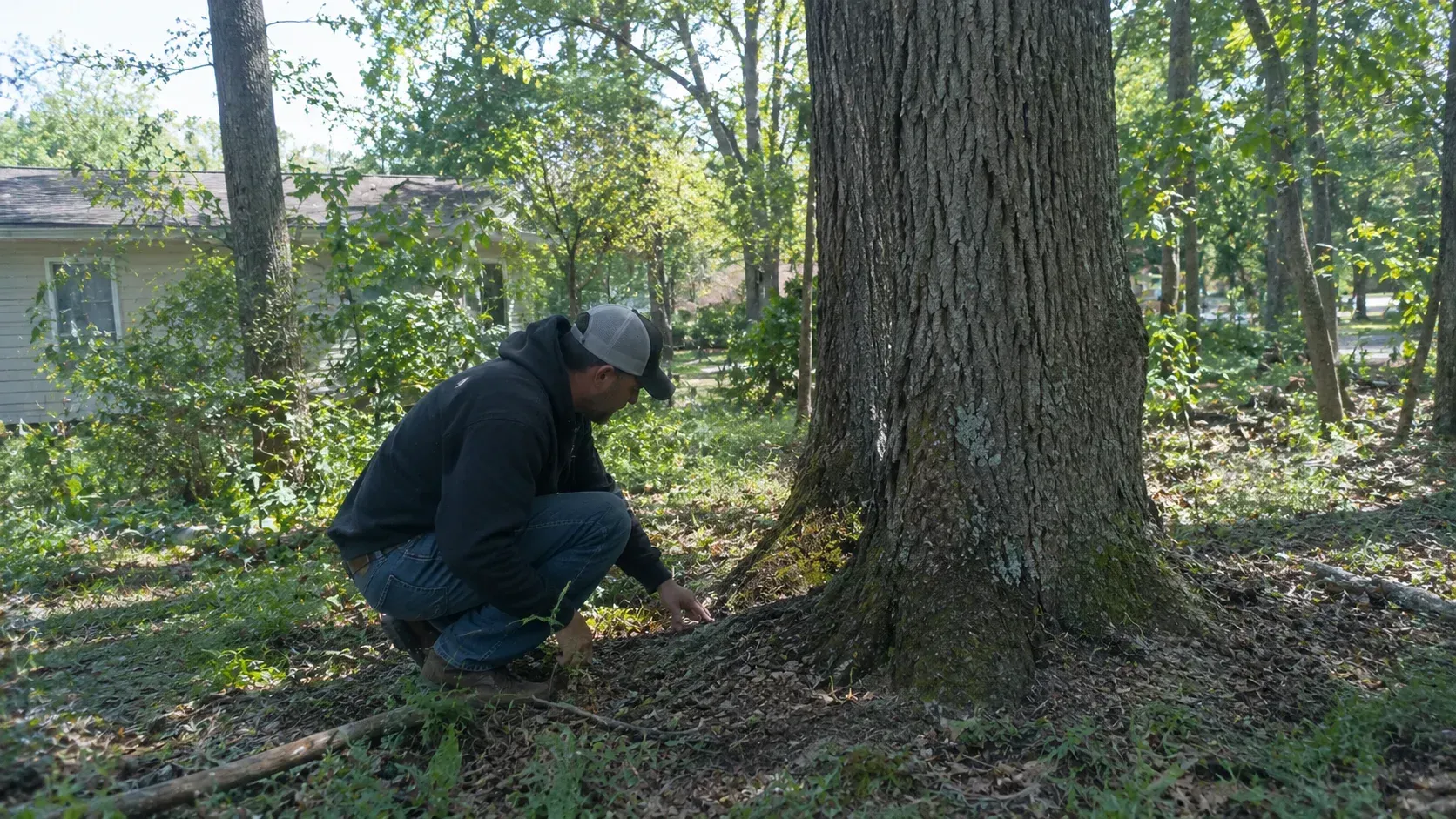
The ground around the base is where a failing tree gives itself away, and it takes two minutes to check.
When a root plate starts to rotate, the roots on the side away from the lean get pulled upward. That lifting shows at the surface before the tree comes down. What to look for, walking a full circle around the trunk:
- A raised ridge or mound of soil on the side opposite the lean, sometimes crescent-shaped
- Cracks in the soil, often curved, following the edge of the root plate
- Turf that has lifted, torn or separated
- A gap between the trunk and the soil on the low side
- Roots that have pulled up out of the ground, or snapped
- Soil that feels soft, spongy or hollow underfoot near the base
- Anything near the tree that has shifted: paving, edging, a fence post, a retaining wall
One important qualifier. Absence of these signs is reassuring but not conclusive, because root decay can compromise anchorage without producing surface movement until the moment of failure. A clean base is good news, not a clearance.
Saturated ground matters here too. Wet soil holds roots far less firmly than dry soil, which is why leaning trees are more likely to go over during or just after heavy rain and snowmelt than during dry weather. If your tree is leaning and the ground is soaked, that is the wrong week to wait and see.
Tree Lean Danger Signs at the Trunk
Once the base is checked, work up the trunk:
- Vertical cracks or seams, particularly ones that have opened or that you can see into
- Bulges or swellings, which can indicate the tree responding to internal decay
- Cavities, holes or soft spots, especially low on the trunk
- Bark falling away in patches with no new bark underneath
- Fungal fruiting bodies anywhere on the stem
- A hollow sound when the lower trunk is struck, keeping in mind this is a crude test
- Old wounds where the trunk was damaged years ago
- A trunk that goes into the ground like a post, with no visible flare
A leaning tree with a sound trunk and undisturbed soil is a much better situation than a leaning tree with a crack at the base. The lean alone does not tell you which you have.
Tree Failure Indicators in the Canopy and Branches
The canopy is the last place to look, not the first, but it does contribute:
- Dieback in the upper canopy, which often reflects root problems
- Leaves noticeably smaller, sparser or off-colour compared to similar trees nearby
- Large deadwood held in the crown
- One side of the canopy noticeably thinner than the other
- Heavy seed production, which can be a stress response
- Branches hanging or broken from an earlier event
- Canopy weight concentrated on the leaning side, which increases the load in the direction the tree is already going
Worth knowing: a tree can have a completely normal canopy and a failing root plate, which is covered in more depth in our piece on why healthy-looking trees fall. Canopy symptoms arrive late, so a good canopy should never override bad signs at the base.
When a Lean Is Not a Problem
Most leaning trees are fine, and it would be dishonest to write this article without saying so clearly.
A lean is generally not a concern when it is long-standing and unchanged, the trunk curves rather than tilting as a straight stem, the soil around the base is undisturbed with no heaving or cracking, there is no visible root damage or exposure, the root collar flare is where it should be, the trunk is sound with no cracks or fungal bodies, the canopy is full and balanced, and nothing valuable sits in the fall zone.
That describes a large share of the leaning trees we get called about. In those cases we tell people the tree is fine and we leave. Sometimes the right answer is reducing canopy weight on the leaning side rather than removal, which is a smaller job than people expect.
What we would not do is put a number on a safe angle. There is no degree of lean that is universally safe or unsafe, because a gentle new lean with a lifting root plate is far more dangerous than a pronounced lean a tree has carried for decades.
What Makes a Leaning Tree Urgent Rather Than Concerning
Two things separate "get it looked at" from "call now":
The signs. Soil heaving or cracking, exposed or snapped roots, a lean that is actively changing, or fresh cracks at the base. Those describe a tree in the process of failing rather than a tree with a defect.
The target. What the tree would hit. A marginal tree over open lawn and the same tree over a bedroom are completely different decisions, and honest assessment weighs both how likely failure is and what happens if it does.
Call immediately, rather than waiting, if the lean is visibly changing, the soil is heaving or cracking, roots have pulled out or snapped, the tree is over a house, driveway, power line or anywhere people spend time, there has been heavy rain or snowmelt on top of any of the above, or the tree is touching or near a power line. That last one goes to the utility rather than to us.
We turn out at any hour for exactly this situation, and a leaning tree over a house after a wet spell is the textbook case for using it.
What to Do Tonight If You Are Worried
Practical, free, and it takes ten minutes:
- Keep everyone out of the fall zone, including pets, and move vehicles.
- Map the fall zone honestly, including where it reaches on the neighbour's side.
- Walk a full circle around the base and look at the soil. This is the important one.
- Photograph it, dated, from the same spots. Repeat in a few days. Two dated photos are the simplest way to know whether a lean is moving.
- Find an old photo of the tree if you can, to establish whether the lean is new.
- Do not prune it, brace it or tie it off. Removing canopy weight from a leaning tree changes its balance unpredictably, and working under a compromised tree is how people get hurt.
- Do not dig around the base to investigate.
- Stay away if it is windy or the ground is saturated.
- If it is near a power line, call the utility, not a tree service.
- Get it assessed rather than deciding from the driveway.
Point four is the one nobody does and it is the most useful. A lean that has moved between two dated photographs a week apart is a different tree from one that has not.
Conclusion
The angle of the trunk is not the question. Whether the root plate is holding is the question, and the ground around the base answers it more reliably than anything you can see from a distance.
New lean plus disturbed soil means a tree that is failing now. Long-standing lean, curved trunk, undisturbed soil and a sound base usually means a tree that has been that way for years and will stay that way. If you cannot tell which one you have, and something valuable sits underneath it, that is what an assessment is for.
Get a Leaning Tree Assessed
If a tree on your property is leaning and you are not sure whether it is a problem, have it looked at rather than watching it. We check the root plate, the soil, the root collar and the trunk, not just the angle, and we will tell you plainly when a tree is sound.
If the lean is changing, the soil is heaving, or the tree sits over your house or driveway, call rather than wait. Arbor Barber Tree Service is open 24/7 for emergency response, and we are locally owned and operated in Lakeville with certified arborists, over 20 years of experience, safety-focused and fully insured.
We serve Lakeville, Apple Valley, Burnsville, Farmington and Rosemount. Call (612) 703-0175, or tell us which way it is leaning and what sits underneath it.
Frequently Asked Questions
How much of a lean is too much for a tree?
There is no safe angle. A slight lean that appeared this year with cracked soil at the base is far more dangerous than a pronounced lean a tree has carried for decades. What matters is whether the lean is new and whether the root plate is stable.
What does soil heaving around a tree mean?
It generally means the root plate is rotating out of the ground, with roots on the side opposite the lean being pulled upward. It is the clearest warning sign a leaning tree gives, and it does not resolve on its own.
Can a leaning tree be straightened or cabled instead of removed?
Cabling and bracing can support some structurally sound trees, but they do not fix root failure. If the tree is leaning because roots broke or decayed, no amount of above-ground support addresses the actual problem.
Why do leaning trees fall during rain rather than in high wind?
Saturated soil grips roots far less firmly than dry soil, so a root plate that was marginally holding can let go in conditions that are not especially windy. Heavy rain and snowmelt are when marginal trees go over.
Should I prune a leaning tree to reduce weight?
Not on your own. Removing canopy weight changes a leaning tree's balance in ways that are hard to predict, and working beneath a compromised tree is dangerous. Reducing sail area can be the right answer, but it should follow an assessment.
Recent Posts