Introduction
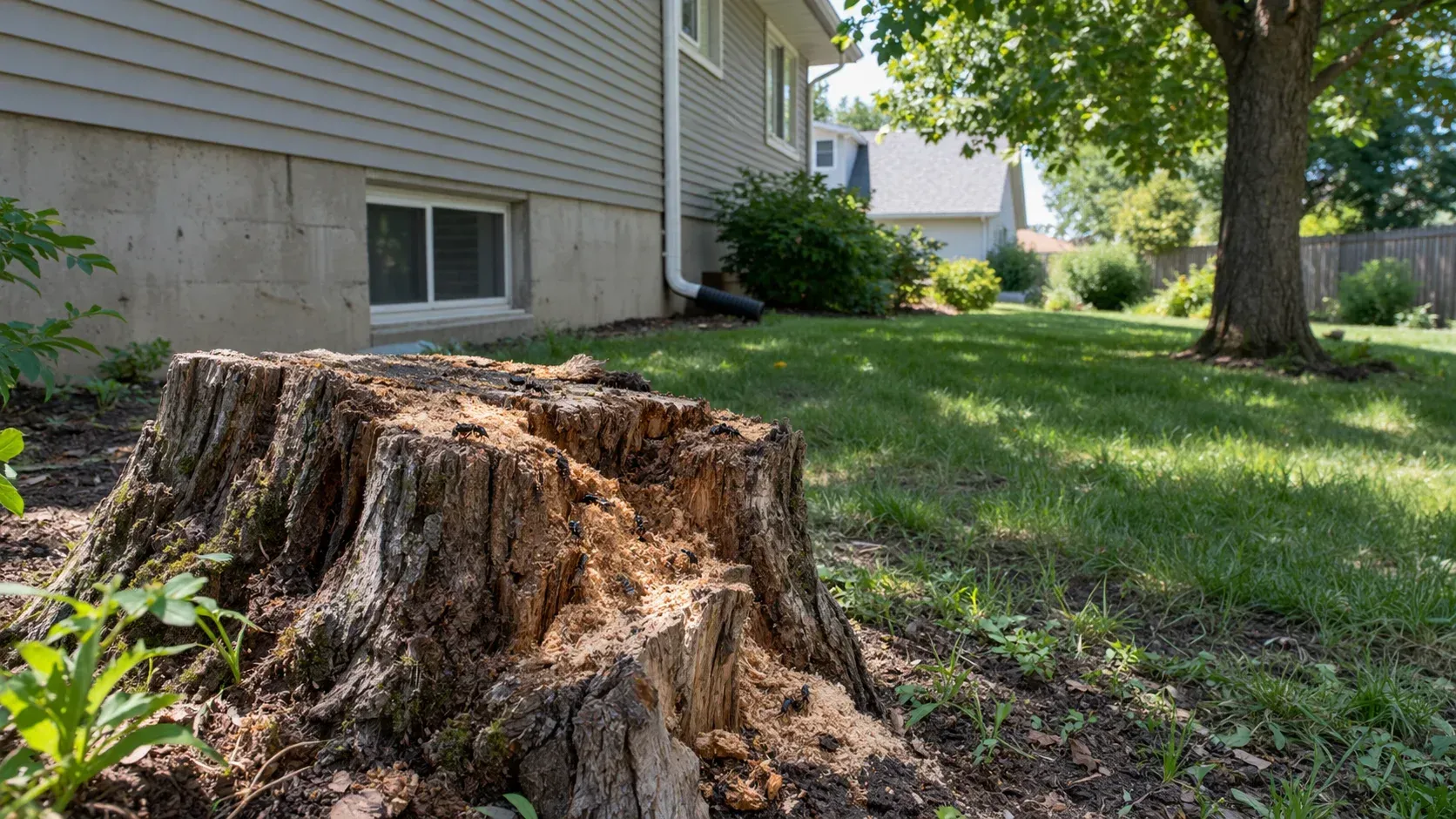
Yes, leftover tree stumps can attract termites, though in Minnesota it's actually carpenter ants that more commonly move into a decaying stump first. Either way,
a stump left to decay near your house
is a realistic pest concern, not an old wives' tale, but the actual risk to your home depends heavily on how close that stump sits and how long it's been sitting there.
This article sorts out what's genuinely true about stumps and pest risk, which insect is actually more likely to show up first, and what distance and decay timeline actually mean for your house specifically.
What's Actually True Here
The core concern is legitimate: decaying wood is exactly what wood-destroying insects look for, and a tree stump left in the ground is essentially a slowly softening block of exactly that. As the wood breaks down, it becomes easier to tunnel through and more appealing as a food source, which is why an old stump can become a staging point for a colony that eventually looks for more wood nearby, including your house.
Where the concern gets exaggerated is in how immediate or inevitable this risk is. A freshly cut stump isn't an instant termite magnet, and a stump on the far side of a large yard doesn't carry the same risk as one sitting a few feet from your foundation. The honest answer sits between "stumps are totally harmless" and "any stump means termites are coming for your house."
Termites and Carpenter Ants: Not Quite the Same Risk
Termites and Decaying Wood
Termites feed directly on wood cellulose, and they're drawn to decaying stumps because softened wood is easier to consume and often already has some moisture content they need. In Minnesota, subterranean termites are the more relevant species, and they build colonies underground, traveling through soil to reach wood sources, including stumps and, eventually, a house's foundation-level wood if conditions allow.
Carpenter Ants and Hollow Stumps
Carpenter ants don't actually eat wood the way termites do, but they excavate galleries inside soft or decaying wood to build nests, which makes an old, hollowing stump an ideal location. In practice, carpenter ants are more commonly the pest found established in a decaying tree stump in this region, and while they don't consume the wood as food, an established carpenter ant colony can still eventually extend into a nearby structure, particularly if there's any moisture-damaged wood on the house providing a similar nesting opportunity.
Why Distance Matters More Than the Stump Itself
A stump's existence isn't the deciding factor, proximity is. Termite colonies and carpenter ant nests don't need to relocate far to reach a new food or nesting source, so a stump within roughly 15 to 20 feet of your home sits close enough that an established colony could plausibly extend its foraging or nesting activity toward the house over time.
A stump at the back of a large property, well away from any structure, presents meaningfully less practical risk, even if it's just as decayed as one sitting near the foundation. This is why the same stump can be a legitimate concern in one location and a non-issue in another, and it's also why an
honest look at where your stumps actually sit
matters more than a blanket rule about stumps in general.
How Long a Stump Stays Attractive to Pests
A freshly cut stump is still relatively dense and dry, which makes it less immediately appealing to either termites or carpenter ants. As the stump ages, moisture increases and the wood begins softening from fungal decay, and this transition typically makes a stump meaningfully more attractive to wood-destroying insects within about two to three years, depending on the tree species, local moisture conditions, and whether the stump was treated in any way after cutting.
Larger stumps from mature trees tend to stay structurally intact longer before becoming fully colonized, while smaller stumps can soften and become appealing more quickly. Either way, the risk isn't static, a stump that seemed like a non-issue when it was first cut can become a genuine concern a few years later without anything else changing except time.
Signs a Nearby Stump Already Has an Infestation
A few indicators suggest a stump near your home already has pest activity worth addressing:
Sawdust-like material, sometimes called frass, accumulating near the base of the stump, which often indicates carpenter ant excavation.
Visible tunneling or hollow sections when you press on or break apart softened areas of the stump.
Winged insects emerging from the stump during spring or early summer, which can indicate either a termite or carpenter ant swarm, the beginning stage of colony expansion.
Ant or insect activity noticeably increasing on the stump during warmer months compared to previous seasons.
If you're seeing any of these on a stump close to your house, that's a reasonable trigger to address the stump directly through
stump grinding
rather than continuing to monitor it, since proximity plus active colonization is the combination that actually creates risk to the structure itself.
Conclusion
Leftover tree stumps genuinely can attract termites, and in Minnesota specifically, carpenter ants are often the more likely pest to move in first. The real risk to your house isn't the stump's mere existence, it's the combination of proximity to your foundation and how long the stump has been decaying, since older, softer stumps within a short distance of the house are the ones that actually matter.
A stump that's been sitting for a few years within 15 to 20 feet of your home is worth taking seriously, particularly if you notice any signs of active colonization.
Addressing tree health and stumps proactively
before decay sets in avoids the question entirely rather than waiting to see whether a problem develops.
Grind Out Old Stumps Near Your Home to Remove a Pest-Friendly Wood Source
A stump that's already been ground down can't host a colony, which is the most direct way to take this particular risk off the table.
Get in touch with Arbor Barber Tree Service
at (832) 703-0175, and we'll take a look at any stumps sitting close to your house and grind out the ones worth removing.