Why Does Ice Break Branches That the Same Amount of Snow Leaves Untouched?
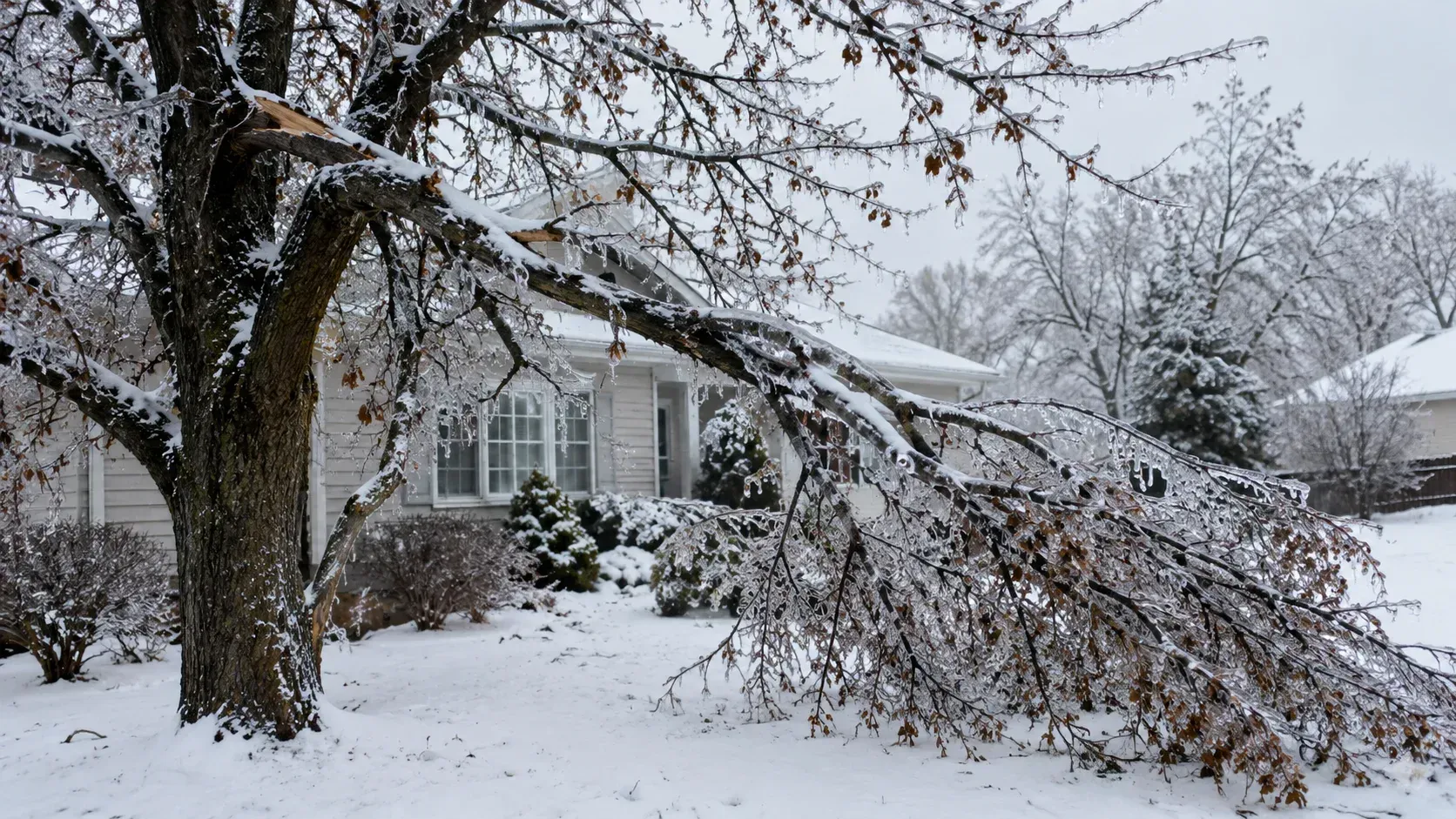
Table of Contents
- Introduction
- Ice Storm Tree Damage vs Snow: Why the Same Depth Behaves Differently
- How Ice Accumulation Branch Breakage Actually Happens
- Why Snow Usually Gets a Chance to Leave
- The Leverage Problem Nobody Thinks About
- Winter Tree Damage in Minnesota: Wet Snow Is the Exception
- Which Trees Lose Branches First in an Ice Storm
- What to Do While the Ice Is Still On
- What to Look For Once It Melts
- Conclusion
Key Takeaways
- Ice bonds directly to bark and forms a continuous shell. Snow sits on top of surfaces and falls off. That adhesion is the whole difference.
- Ice coats every twig, so the loaded surface area on a mature tree is enormous compared to what snow accumulates on.
- Snow sheds through wind, sliding and branch flex. Ice removes all three of those escape routes, so the load only goes up.
- Once a branch bends under ice, it presents more surface to collect more ice. The loading is self-reinforcing until something gives.
- Wet, heavy snow is the exception and behaves much more like ice, which is why late-season storms here do real damage.
Introduction
Ice breaks branches that snow leaves alone because ice bonds directly to the bark and forms a continuous shell that cannot blow off, slide off or be shaken loose. Snow sits on top of a branch and leaves at the first good gust. Ice becomes part of the branch, coating every twig and small stem, and the load keeps accumulating until the wood fails.
After an ice event around Lakeville we spend the following week clearing broken limbs and downed wood, and the same conversation comes up every time. The homeowner points out that they had far more snow in January and nothing happened. They are right, and the reason is worth understanding, because it also tells you which trees on your property are most at risk next time.
Here is the actual mechanism.
Ice Storm Tree Damage vs Snow: Why the Same Depth Behaves Differently
Three things separate the two, and they compound.
Density. Ice is solid water. Fresh dry snow is mostly air, packed loosely into a structure that takes up far more space than the water it contains. A given depth of ice therefore carries dramatically more actual weight than the same depth of fluffy snow.
Adhesion. This is the one that matters most. Freezing rain lands as liquid and freezes on contact, which means it bonds to the surface rather than resting on it. Snow accumulates by piling up. A branch coated in ice is carrying that ice until it melts, whatever the wind does.
Coverage. Snow collects mainly on upward-facing surfaces. Ice coats the whole circumference of everything it touches, including the undersides, the sides, and every small twig out at the ends of the branches. On a mature tree that is a staggering amount of surface area, and every bit of it is collecting weight.
Put those together and an ice event loads a tree in a way a comparable snowfall simply cannot.
How Ice Accumulation Branch Breakage Actually Happens
The sequence is consistent, and it explains why failures often happen hours after the freezing rain stops.
Freezing rain begins and coats every exposed surface. The fine twigs at the outer edges of the canopy load first, because they present the most surface relative to their strength and they are farthest from the trunk.
Branches begin to bend under the weight. That bending is where it starts going wrong, because a bent branch presents a different profile to falling rain and often collects more, not less. The load and the deflection reinforce each other.
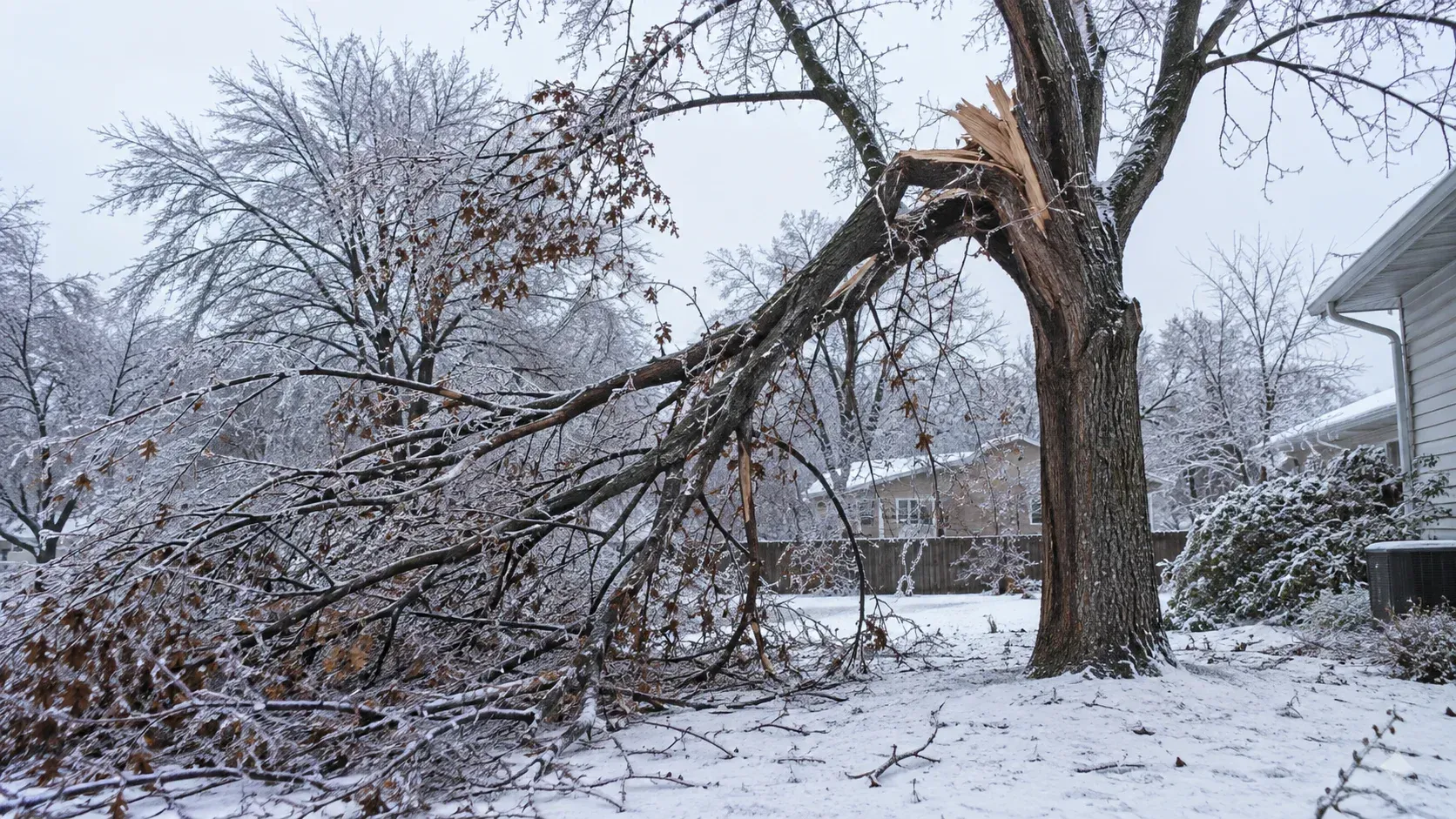
Wood under sustained bending eventually reaches its limit. Some branches fail during the storm. Many fail afterward, once the accumulated weight has been working on the wood for hours, or when a light wind adds a dynamic load on top of the static one.
Then the failures cascade. A large limb coming down through a canopy takes smaller branches with it, and it can leave the remaining tree unbalanced in a way that causes the next failure.
That cascading stage is why we tell people to stay away from loaded trees even after the weather has cleared. The tree is still working through the consequences.
Why Snow Usually Gets a Chance to Leave
Snow has three ways off a tree, and ice has none of them.
- Wind. Dry snow blows off readily. A breeze that would do nothing to an ice-coated branch clears a snow-covered one.
- Sliding. Snow slides off angled surfaces under its own weight as it accumulates.
- Branch flex. This is the elegant one. As a branch bends under snow, it changes angle, and the snow slides or drops off. The branch springs back. Trees are, in effect, self-clearing under dry snow.
Ice defeats all three. It will not blow off because it is bonded. It will not slide because it froze in place. And branch flex does not help, because the ice bends with the branch and stays attached.
Which is why the tree that shrugged off a foot of January powder can lose major limbs to a quarter of that depth in ice. The tree never got a chance to unload.
The Leverage Problem Nobody Thinks About
There is a structural dimension on top of the weight, and it explains why long branches fail before short thick ones.
A branch is a lever anchored at the trunk. Weight out near the tip exerts far more force at the attachment point than the same weight close to the trunk. Ice loads the entire length, but the outer portions carry the most surface area relative to their strength, and they sit at the end of the longest lever.
So the failure point is usually not where the ice is heaviest. It is at the union where the branch meets the trunk, or at a weak point partway along. That is also why trees with structural defects fail in ice events while their neighbours do not: the ice does not create the weakness, it finds it.
Branch angle matters here too. Narrow, upright unions where bark has become included between the branch and the trunk are weaker than wide, open unions, and ice loading is very good at finding them.
Winter Tree Damage in Minnesota: Wet Snow Is the Exception
Everything above treats snow as the lighter problem, and usually it is. Wet snow is the exception, and here it is a significant one.
Snow falling at temperatures near freezing carries much more water and much less air, which makes it far heavier than dry powder at the same depth. It also sticks. It clumps onto branches and stays there rather than blowing off, which removes the self-clearing behaviour that makes dry snow relatively harmless.
Heavy wet snow therefore behaves much more like ice than like the January powder people are comparing it against. Late fall and early spring storms are the usual culprits, and a late-season storm that catches trees with leaves still on is worse again, because the foliage gives the snow far more to hold onto.
The practical implication for anyone here: judge a snow event by how wet and sticky it is, not by how deep it is.
Which Trees Lose Branches First in an Ice Storm
Some trees are consistently worse off, and the pattern is about structure and wood properties rather than luck:
- Fast-growing species with lower wood density. Rapid growth generally produces weaker wood.
- Trees with narrow, upright branch unions, particularly with included bark.
- Trees with codominant stems, meaning two competing trunks rather than one clear leader.
- Long, horizontal, heavily extended limbs, which have the worst leverage.
- Trees with dense fine branching, which collects proportionally more ice.
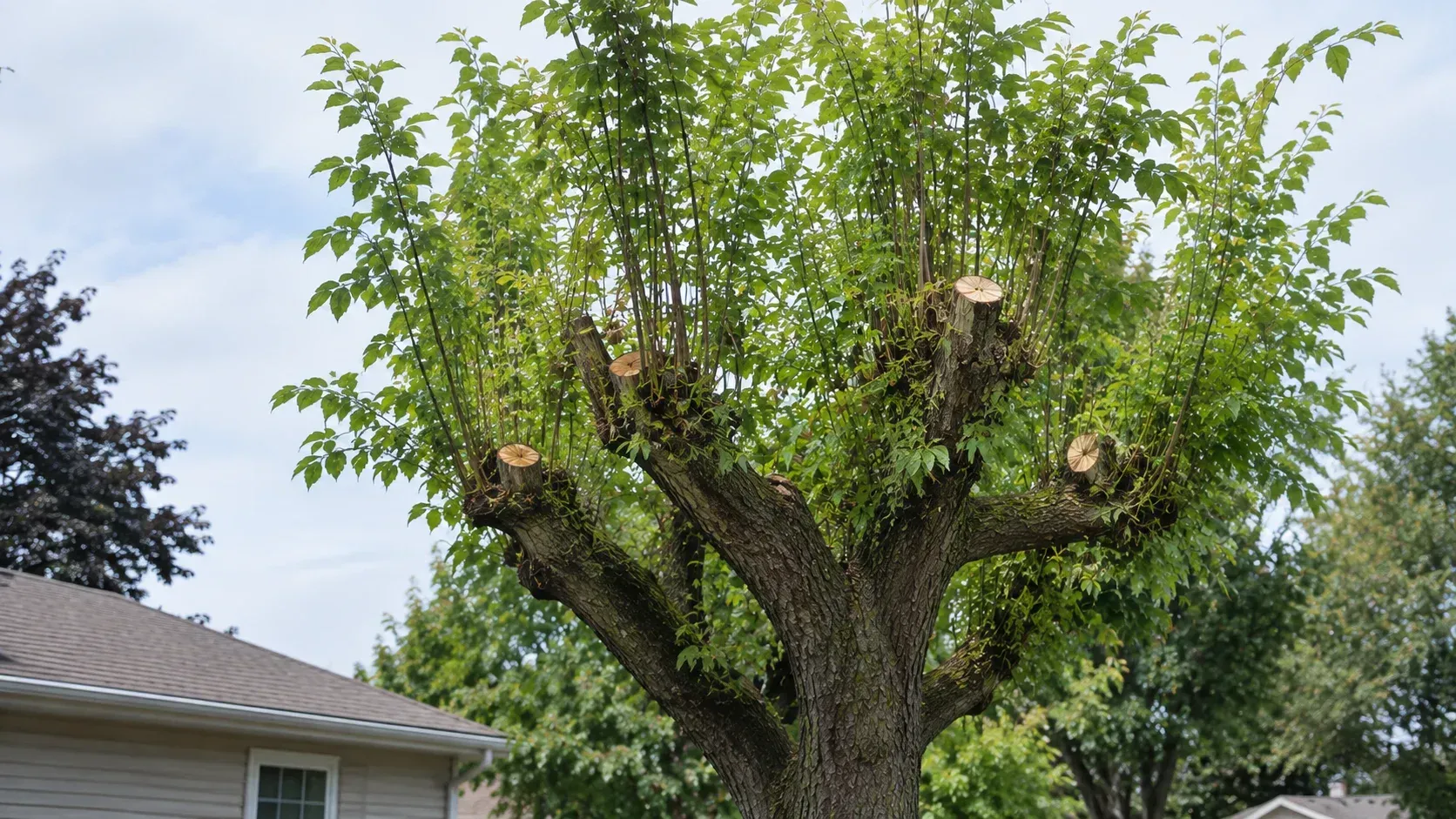
- Previously topped trees. The weak, densely clustered shoots that regrow after topping are poorly attached and load heavily. Ice storms find them reliably.
- Trees with existing decay or old wounds, where the margin is already reduced.
- Trees that have had roots cut or damaged, which affects whole-tree stability rather than individual branches.
Notice how many of those are structural conditions that were visible long before the storm. That is the argument for having trees looked at in advance rather than after.
What to Do While the Ice Is Still On
Short list, and the first item is the important one:
- Stay out from under loaded trees. Branches fail without warning during and after an ice event, and they fail during the thaw as well.
- Do not try to knock the ice off. Striking or shaking an ice-loaded branch is a good way to cause the failure you are trying to prevent, while standing underneath it.
- Do not prune anything while it is loaded. Frozen wood is brittle and the branch is under tension.
- Keep away from anything near a power line, and call the utility rather than a tree service for that.
- Move vehicles out from under large trees if you can do it safely.
- Park elsewhere and use another door if a loaded limb is over your driveway or entry.
- Let it melt. Most of what looks alarming resolves without intervention.
The instinct to go out and help the tree is understandable and it is the main way people get hurt in these events.
What to Look For Once It Melts
Once everything has come off, walk the property and look for:
- Branches that have broken but are still hanging in the canopy. These are the most dangerous thing left and they will come down eventually
- Cracks at branch unions, particularly where a limb has partially torn
- Splits running into the trunk from a failed branch
- Bark torn away where a limb ripped out
- Limbs that are now resting on the roof, a fence or a line
- A canopy that is noticeably unbalanced after losses on one side
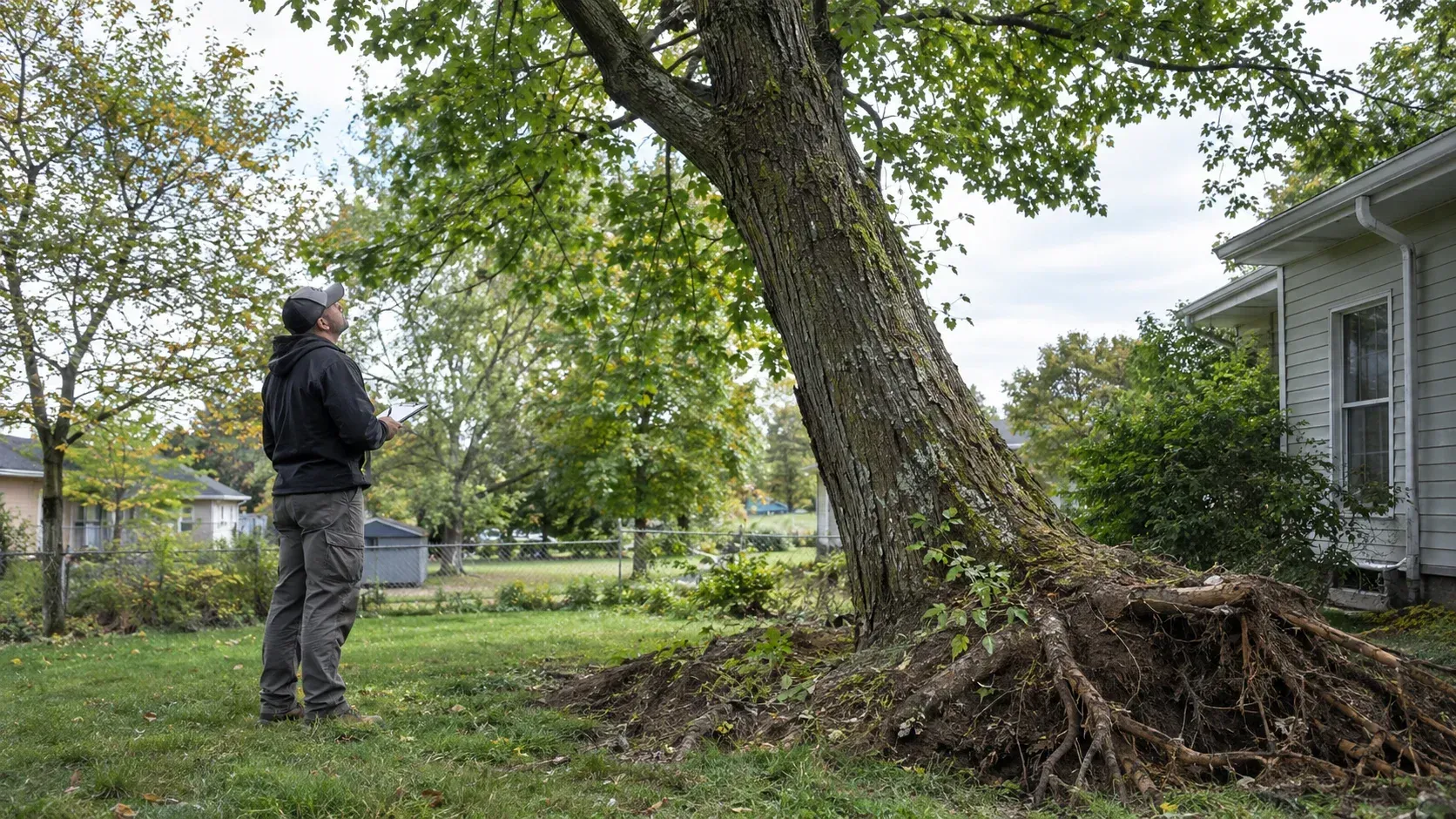
- Any new lean, or disturbed soil at the base
- Deadwood that was loosened but has not yet fallen
Hanging branches are the priority. They are not stable, they are usually out of reach, and they tend to come down at the least convenient moment.
Conclusion
Ice wins because it sticks. Snow loads a tree and then leaves, through wind, sliding and the branch's own flexing. Ice bonds to every twig, coats the full circumference, cannot shed, and keeps accumulating out at the ends of the longest levers on the tree.
Most of what fails in an ice storm was already carrying a structural weakness. The ice simply applied the test. That is also the useful takeaway: the time to deal with a poorly attached limb or a codominant stem is a quiet afternoon in autumn, not the morning after freezing rain.
If Ice Has Cracked Your Branches, Get Them Down Before They Fall
Hanging limbs and cracked unions do not stabilize on their own. If an ice event has left damage in your canopy, getting it cleared is considerably safer than waiting for the next wind to decide when it comes down.
We assess storm-related damage, remove debris and damaged trees safely, and leave the area cleaned and secured. Arbor Barber Tree Service is open 24/7, locally owned and operated in Lakeville, with certified arborists, over 20 years of experience, safety-focused and fully insured.
If a limb is on your house, blocking access or near a line, say so when you call. We serve Lakeville, Apple Valley, Burnsville, Farmington and Rosemount. Call (612) 703-0175, and for anything urgent we respond around the clock.
Frequently Asked Questions
How much ice does it take to start breaking branches?
Less than people expect, and far less depth than snow. Because ice bonds to every surface and cannot shed, a coating that looks modest can load a mature canopy heavily. The tree's structure matters more than the exact thickness.
Should I knock ice off my trees?
No. Striking or shaking an ice-loaded branch frequently causes the break you are trying to prevent, and you are standing underneath it when it happens. Frozen wood is brittle. Let it melt.
Why did my neighbour's tree lose limbs and mine did not?
Usually structure rather than luck. Narrow branch unions, codominant stems, previous topping, long extended limbs and existing decay all fail earlier under ice load. The storm finds weaknesses that were already there.
Is wet snow as dangerous as ice?
It can be. Snow falling near freezing carries far more water, sticks to branches instead of blowing off, and loads heavily. A wet snow event behaves much more like ice than like dry powder at the same depth.
What should I do about a branch left hanging in the canopy?
Stay out from underneath it and have it removed. Hanging limbs are unstable, usually out of safe reach from the ground, and they come down on their own schedule. This is the most common post-storm hazard we deal with.
Recent Posts