How Do You Know If a Tree Has Internal Decay With No Visible Damage on the Outside?

September 28, 2026

Share this article

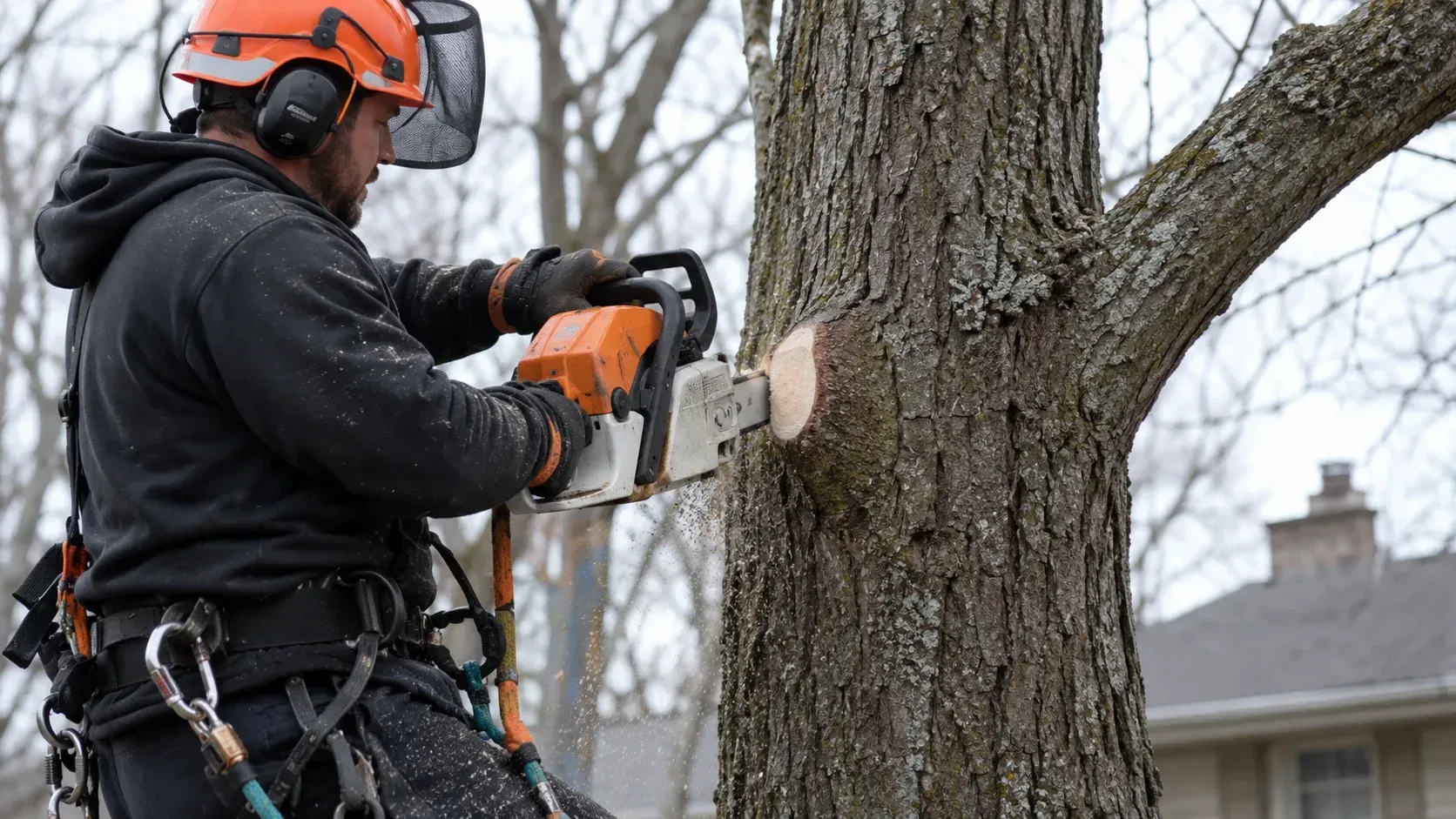
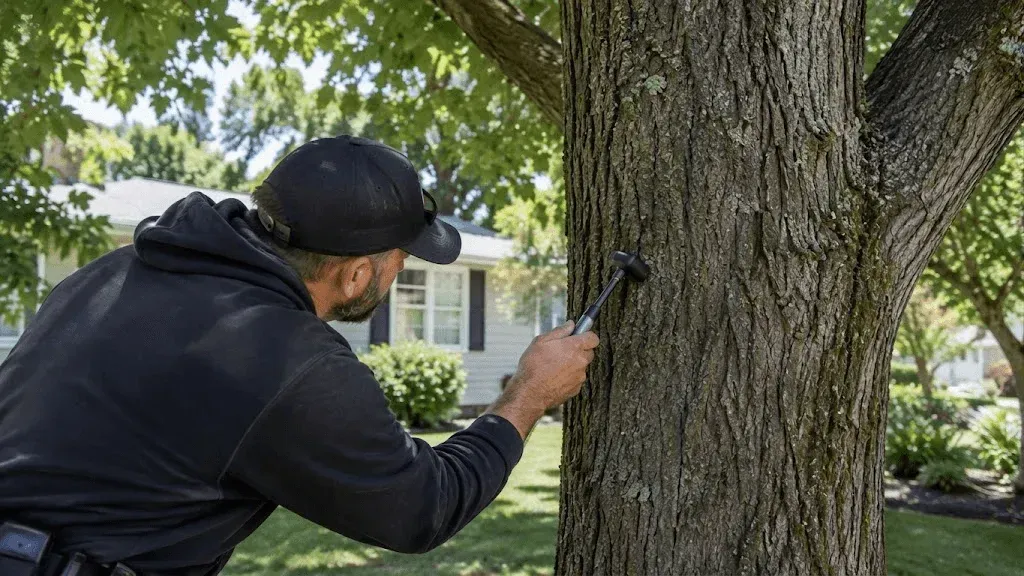
An arborist tapping a tree trunk with a rubber mallet to demonstrate how do you know if a tree has internal decay with no visible damage on the outside.

Table of Contents

  1. Introduction
  2. The Signs of Internal Tree Decay You Can Check From the Ground
  3. Fungal Conks on a Tree Trunk Are the Finding That Matters Most
  4. The Hollow Tree Sound Test and What It Actually Proves
  5. Where to Look, in the Order a Professional Looks
  6. Hidden Tree Rot: The Places Decay Starts That Nobody Checks
  7. What Each Finding Means, and What It Does Not
  8. How Professionals Detect Decay You Cannot See
  9. Why a Hollow Tree Is Not Automatically a Dangerous Tree
  10. Conclusion
  11. Request a Trunk and Root Inspection If You Notice Any of These Signs
  12. Frequently Asked Questions


Key Takeaways

  • Fungal conks or mushrooms on the trunk, base or surface roots are the most significant thing a homeowner can find. They generally mean decay is already well established inside.
  • The tap test is real but crude. A hollow sound is worth acting on; a solid sound proves very little.
  • Check the bottom three feet of the trunk and the root flare first. That is where the decay that matters most tends to be.
  • Decay alone does not mean removal. What matters is how much sound wood is left, where it sits, and what the tree would hit.
  • Every method available from the ground has real limits. They tell you whether to get it assessed, not whether the tree is safe.

Introduction

Internal decay usually shows itself from the outside before it shows in the canopy, but the clues are small and in places nobody looks. Mushroom-like fungal conks growing at the base or on the trunk, a hollow or drum-like sound when the lower trunk is tapped, vertical seams or cracks running through otherwise smooth bark, and a trunk that enters the ground with no visible flare are the main ones. None of them require equipment, and all of them are on the lower part of the tree rather than up in the branches.


Inspections for decay around Lakeville spend most of their time on the bottom few feet of a tree for exactly this reason. That is where the findings are, and it is the part homeowners walk past.


This article is about how to check, and just as importantly, what each thing you find actually tells you.


The Signs of Internal Tree Decay You Can Check From the Ground

Take fifteen minutes and walk a full circle around the tree, looking at the trunk and the ground rather than up. What you are looking for:

  • Fungal conks or mushrooms on the trunk, at the base, or on surface roots. The most important item on this list.
  • A hollow or drum-like sound when the lower trunk is struck with a mallet or the heel of your hand.
  • Vertical seams or cracks in otherwise intact bark, particularly ones that run for a distance or that you can see into.
  • A missing root flare. A healthy tree widens where it meets the soil. A trunk that goes into the ground like a post is a warning.
  • Cavities, holes or openings, including old pruning wounds that never closed.
  • Soft, spongy or crumbling wood where you can reach it, particularly at the base.
  • Bark sloughing off in patches with nothing regrowing underneath.
  • Sawdust-like material at the base, or carpenter ant activity.
  • Bulges or swellings on the trunk, which can indicate the tree reinforcing around a weak area.
  • Woodpecker activity in one concentrated spot, which often means insects in decaying wood.
  • Old wounds from lawn equipment, vehicle strikes, storm damage or past pruning.


Canopy symptoms such as thinning or dieback do appear eventually, but they arrive late. By the time the canopy tells you something, the trunk has been telling you for years.


Fungal Conks on a Tree Trunk Are the Finding That Matters Most

If you find one thing on the list above, this is the one to act on.


Decay in trees is a fungal process. The fungus lives inside the wood, consuming it, and for most of its life it is entirely invisible from outside. A conk, the shelf-like or bracket-shaped growth you see on trunks, is the fruiting body. It is the reproductive structure the fungus produces once it is established.


Which is why the finding matters so much. A visible conk generally means the decay inside is not beginning, it is mature. The fungus has consumed enough wood to support producing fruiting bodies.


What to note if you find one:

  • Where it is. At the base or root flare is more concerning than high on the trunk, since that is where the whole load is carried.
  • How many. Multiple conks, or conks at several heights, suggest a more extensive decay column.
  • Whether they recur. Some appear seasonally. Their absence in winter does not mean the decay stopped.
  • Photograph them. Different decay fungi behave differently and some are far more serious than others, so a photograph lets an arborist identify which you are dealing with.


Do not knock them off. Removing the fruiting body does nothing to the fungus inside and it destroys the evidence that would have told an arborist what is happening.


Mushrooms growing in the soil near a tree are a different matter, and usually harmless. Many soil fungi are beneficial. What matters is growth attached to the trunk, the root flare, or a surface root.


The Hollow Tree Sound Test and What It Actually Proves

The tap test is real, it is genuinely useful, and it is also widely overinterpreted.


How it is done: strike the lower trunk with a rubber mallet, or the heel of your hand, working around the circumference and up the first several feet. Sound wood gives a solid, dull thud. Decayed or hollow wood gives a higher, drum-like, resonant sound. Working around the trunk lets you compare one area against another, which matters more than any single strike.


What it can tell you: a distinctly hollow-sounding area is meaningful and worth following up.


What it cannot tell you, and this is the part people get wrong:

  • A solid sound does not prove sound wood. A decay column deep inside a large trunk, with several inches of sound wood around it, can sound completely normal.
  • It cannot measure anything. It suggests decay may be present. It says nothing about how much wood is left or how much strength remains.
  • It is affected by bark thickness, species, tree size and moisture, all of which change the sound.
  • It reaches only where you can reach. Decay higher in the trunk or in a major union is out of range.
  • It is subjective. It relies on comparing one part of a trunk to another by ear.


So use it as a screening tool. A hollow sound is a reason to get the tree assessed. A solid sound is not a clearance, and treating it as one is the most common mistake made with this method.


Where to Look, in the Order a Professional Looks

The sequence matters, because the highest-consequence findings are at the bottom.


  1. The root flare and the bottom foot of trunk. Decay here affects the tree's entire structural support and is the most serious. Clear away any mulch, soil or ivy covering it, because this is exactly the area people bury.
  2. The surface roots, radiating out from the base. Look for conks, soft wood, damage and missing roots.
  3. The soil around the base, for heaving, cracking, depressions or disturbance.
  4. The lower trunk, all the way around. Walk the full circle. Decay is frequently on one side only, and people check the side they approach from.
  5. The main trunk upward, for seams, cavities, bulges, old wounds and bark condition.
  6. The major branch unions, where limbs meet the trunk. Included bark and decay at unions are common.
  7. The canopy, last. Deadwood, thinning, dieback, and whether it looks balanced.
  8. The site history. Construction, trenching, grade changes, past topping, storm damage, vehicle strikes. What happened to this tree.


Point one deserves emphasis. The most common thing we find hiding a serious problem is mulch or soil piled against the trunk. It keeps the bark wet, invites decay, and hides the area that matters most. If you cannot see the flare, that is a finding in itself.


Hidden Tree Rot: The Places Decay Starts That Nobody Checks

Decay needs an entry point, and the entries are usually old and closed over. Common ones:

  • Old pruning wounds, especially flush cuts that removed the branch collar or stubs that died back
  • Lawn mower and string trimmer damage at the base, accumulated over years of small strikes
  • Vehicle or equipment strikes on the trunk
  • Storm-torn limbs, where the tear left a ragged wound
  • Cracks from freeze and thaw cycling
  • Root damage from construction, which lets decay into the root system rather than the trunk
  • Buried root flare, from mulch or added soil
  • Old topping cuts, which are among the worst possible entry points because they are mid-stem with no collar
  • Included bark at a union, which creates a moisture-trapping seam
  • Lightning damage, sometimes with only a thin visible scar


The common thread is that most of these happened years or decades ago and are no longer obvious. A tree with a smooth, closed-over trunk can have a substantial decay column that entered through a wound in the 1990s.


What Each Finding Means, and What It Does Not

Worth being precise, because the gap between finding something and knowing what it means is where people either panic or dismiss it wrongly.
Finding What it suggests What it does not tell you
Fungal conks on trunk or base Established internal decay How extensive it is, or how much strength remains
Hollow sound when tapped Possible decay or cavity in that area Depth, extent, or remaining wall thickness
Solid sound when tapped Nothing conclusive Whether decay exists deeper in
Vertical seam or crack Possible internal defect Whether it is structural or superficial
Open cavity Decay present and exposed Whether the tree is unsafe
Missing root flare Buried flare, girdling roots, or decay Which of those it is
Soil heaving at base Possible root plate movement Whether it is progressing
Canopy dieback Tree is in decline The cause, which may not be decay at all

Notice how many rows say the same thing in the right-hand column. Ground-level checks are good at telling you something is worth looking at. They are poor at telling you how serious it is, and the difference between those two questions is the whole reason assessments exist.


How Professionals Detect Decay You Cannot See

Beyond looking and tapping, there are methods for getting at what is actually inside. Worth knowing they exist, particularly on a valuable tree or one over something important.


  • Systematic sounding, done with the right mallet around the full circumference and up the stem, comparing regions against each other.
  • Probing, using a thin probe in cavities to find the extent of soft or missing wood.
  • Increment boring, taking a small core to examine the wood, though this wounds the tree and is used selectively.
  • Resistance drilling, in which a fine needle is driven into the trunk and the resistance recorded, producing a profile of sound and decayed wood along that line.
  • Sonic tomography, using sound transmission through the trunk to build a cross-sectional picture of the decay without drilling.
  • Root crown excavation, removing soil from the flare to inspect what is buried, which is frequently where the answer is.


Not every tree warrants the involved methods, and they carry costs and sometimes minor wounding. But on a mature tree over a house, where the question is whether it stays or goes, actual data about the remaining sound wood is a different conversation from a judgment call made from the ground.


If you want to know what is inside a specific tree, ask what assessment methods are available rather than accepting a verdict based on appearance.


Why a Hollow Tree Is Not Automatically a Dangerous Tree

This is the correction that matters most, and it runs against intuition.


A hollow trunk resists bending better than people assume. Structural strength in a cylinder is concentrated toward the outside, which is why steel tubing is used in place of solid bar in plenty of engineering applications. A tree that is hollow in the middle but has a sound shell of wood around it can be entirely stable, and many hollow trees stand for decades.


What actually determines risk:

  • How much sound wood remains, and its thickness relative to the trunk
  • Whether it is uniform. A hollow with an even wall is far better than one where decay has eaten through on one side
  • Whether there is an opening, which concentrates stress at its edges
  • Where the decay is. At the base, carrying the whole tree, is worse than higher up
  • How the tree is loaded, including canopy size, lean and exposure to wind
  • Whether it is progressing or has been stable for years
  • What is underneath it


That last one is not a property of the tree at all, and it frequently decides the outcome. The same hollow tree over open pasture and over a child's bedroom are different decisions, because risk is likelihood combined with consequence.


Which is why we will not tell you a tree needs removal because it is hollow, and equally will not tell you it is fine because it looks healthy. Where the decay leaves a tree genuinely compromised over something that matters, the tree has to come out. Plenty of hollow trees do not need it.


Conclusion

Internal decay announces itself at the bottom of the tree, not the top. Conks on the trunk or root flare, a hollow sound low on the stem, seams in smooth bark and a flare you cannot see are the findings worth acting on, and all of them are available to anyone willing to walk a circle around the tree.


What those findings cannot do is tell you how serious it is. Every ground-level check is good at raising the question and poor at answering it, which is the honest limit of a checklist like this one. Use it to decide what deserves a closer look.


Request a Trunk and Root Inspection If You Notice Any of These Signs

If you have found conks on a trunk, a hollow-sounding base, or a tree whose flare has disappeared under mulch, that is worth having looked at properly. We check the root collar, the soil, the trunk and the structure rather than judging from the canopy, and we will tell you plainly when a tree is sound.


Arbor Barber Tree Service is locally owned and operated in Lakeville, with certified arborists and over 20 years of experience, safety-focused and fully insured. We serve Lakeville, Apple Valley, Burnsville, Farmington and Rosemount.


Call (612) 703-0175, or describe what you have found through the site.

Frequently Asked Questions

  • Are mushrooms growing on my tree a bad sign?

    Growth attached to the trunk, root flare or a surface root generally indicates established internal decay, and it is the most significant thing a homeowner can find. Mushrooms in the soil nearby are usually harmless and often beneficial.

  • Does a hollow sound mean my tree has to come down?

    No. A hollow sound is a reason to have the tree assessed, not a verdict. Hollow trunks can remain structurally sound depending on how much wood is left and where, and many hollow trees stand safely for decades.

  • If the trunk sounds solid, is the tree safe?

    Not necessarily. A decay column deep inside a large trunk with several inches of sound wood around it can sound completely normal. The tap test is a screening tool, and a solid sound is not a clearance.

  • Should I knock fungal conks off my tree?

    No. Removing the fruiting body does nothing to the fungus inside the wood, and it destroys evidence an arborist would use to identify which decay organism is present, which affects how serious the situation is.

  • Can decay inside a tree be treated or stopped?

    Not reversed. Trees wall decay off rather than healing it, and wood already consumed does not come back. Management focuses on reducing load, removing hazardous parts, monitoring progression, and deciding whether the tree remains acceptable where it stands.

Recent Posts

Examining pest risks to ask: Is It True That Leftover Tree Stumps Attract Termites to Your House?
September 28, 2026
Tree stumps can genuinely attract termites and carpenter ants, but the real risk to your house depends mostly on distance and how long the stump has decayed.
Arborist inspecting damage from emerald ash borer confirmed in just one branch of a tree.
September 28, 2026
Emerald ash borer confirmed in one branch rarely stays contained. Learn the realistic timeline, your options, and how the infestation likely progresses next.
Arborist checking an oak tree: What happens once emerald ash borer is confirmed in a branch?
September 28, 2026
Oak trees losing leaves in summer can signal oak wilt, drought stress, or fungal disease. Learn how to tell the difference and what to check first right away.
Arborist pruning a branch: Is It True That Pruning an Oak Tree in Summer Can Get It Infected With a
September 28, 2026
Learn why pruning oak trees in summer increases oak wilt risk in Minnesota, how the disease actually spreads, and when it's truly safe to prune oaks instead.
Tree with exposed roots by an excavator, showing why trees die after construction damage.
September 28, 2026
Learn why trees sometimes die years after construction damaged their roots, how this delayed decline develops, and which symptoms signal long-term trouble.
Fresh pruning cut bleeding heavy sap what happens if a maple or birch tree is pruned wrong.
September 28, 2026
Learn what happens when maple or birch trees are pruned at the wrong time of year, including sap bleeding, borer risk, and the correct pruning window overall.
A topped tree showing why some trees grow back faster but weaker after trimming.
September 28, 2026
Learn why some trees produce fast, weak regrowth after trimming, what epicormic shoots actually are, and how improper cuts trigger this stress response overall.
Topped tree: is it true that topping a tree makes it grow back thicker and fuller?
September 25, 2026
Learn why topping a tree doesn't actually make it grow back fuller or healthier, what epicormic sprouts are, and why proper pruning works better long-term.
Which pruning cut actually causes more long-term damage: flush cut or branch collar?
September 25, 2026
Compare flush cuts and cuts beyond the branch collar to see which pruning method causes more long-term tree damage and how proper cut placement really works.
Ice storm: what happens if a storm-damaged tree is left standing through Minnesota winter?
September 25, 2026
Learn what happens when storm-damaged trees are left standing through a Minnesota winter, including freeze-thaw cracking and added ice and snow load risks.
Show More